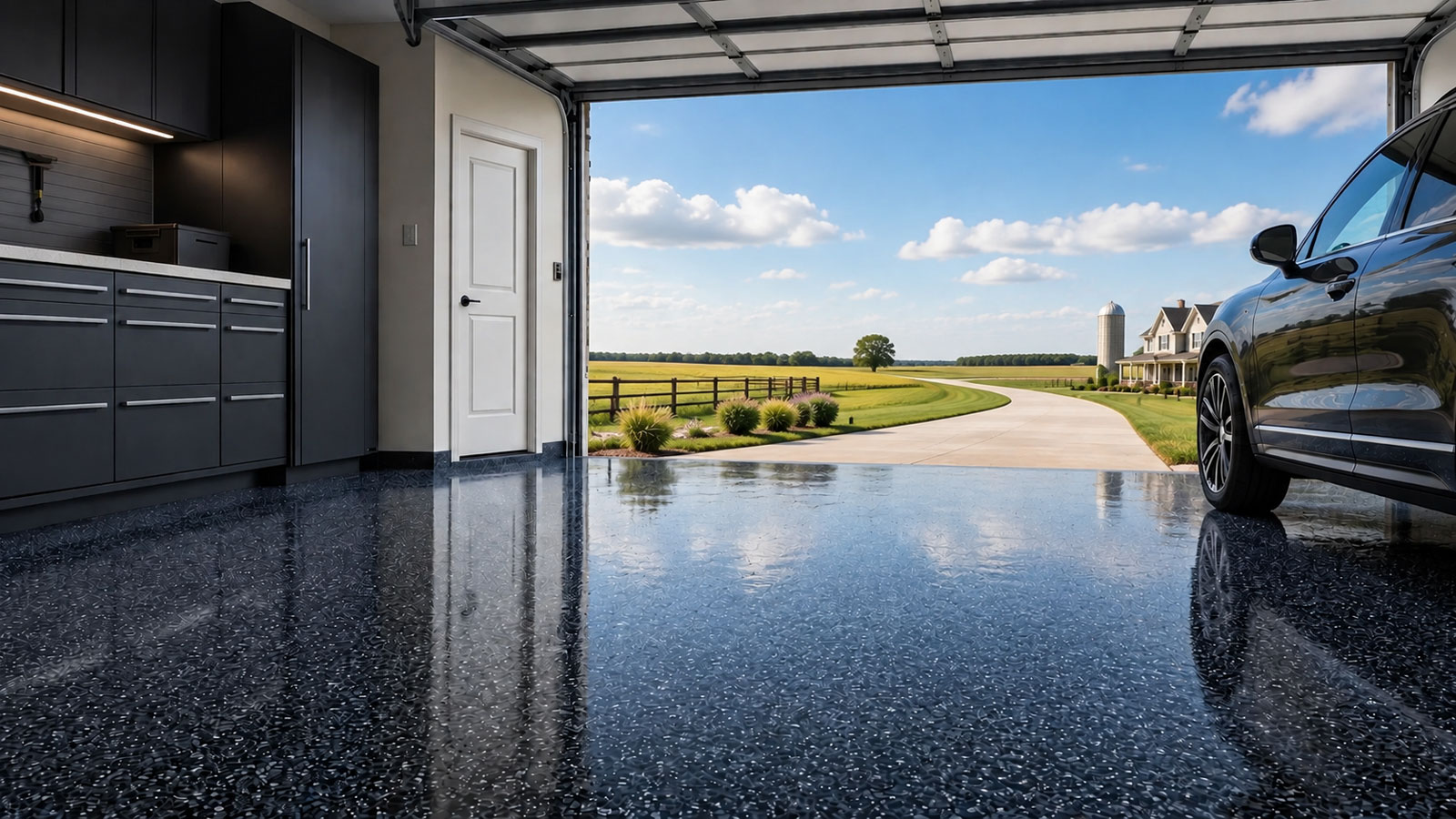
Garage Floor Coating in La Vista, NE
Floor Coating Services in La Vista, NE
La Vista is one of the Omaha metro's clearest planned-suburb stories. It incorporated in 1960 after beginning as a 335-home subdivision on about 80 acres with roughly 1,360 residents, and it has since grown into a city of more than 18,000 people. That mid-century base means some La Vista garages have accumulated decades of paint, salt exposure, repairs and later modifications, while infill or redevelopment can introduce much younger slabs with builder treatments. The two situations require different kinds of preparation.
La Vista follows regional stormwater design standards and sits within the Papillion Creek watershed. Its established street network and later infill mean some garages rely on older drainage layouts while newer projects use more modern storm-sewer and detention practices. Regional stormwater standards provide a framework, but they do not guarantee identical drainage on every street. Driveway grade, low spots, roof discharge and actual threshold water remain the useful property-level checks.
A 1960s- or 1970s-era garage may have decades of paint, repairs, salt exposure, and previous coatings, while newer redevelopment or infill can bring younger concrete with sealers and builder patching. Both need mechanical preparation, but for different reasons.
Local Market Insight
La Vista’s 1960 planned-suburb origins create a recognizable base of mid-century garage concrete alongside later infill and redevelopment. Older floors may bring decades of paint, repairs, and winter wear, while newer concrete shifts the focus toward sealers, smooth finishes, and modern drainage layouts.
What Affects the Cost of Garage Floor Coating in La Vista?
La Vista's planned-suburb origins create a large mid-century garage stock alongside later infill and redevelopment. Older floors may need paint, patches and winter contamination addressed; younger slabs may require sealers or curing products removed. Papillion Creek drainage, lot grading, garage layout and household use can further change scope.
Development-era slab history
La Vista is one of the Omaha metro's clearest planned-suburb stories. It incorporated in 1960 after beginning as a 335-home subdivision on about 80 acres with roughly 1,360 residents, and it has since grown into a city of more than 18,000 people. That history can change whether the main work is coating removal and repair or profiling a relatively young floor.
Local drainage and threshold water
La Vista follows regional stormwater design standards and sits within the Papillion Creek watershed. Its established street network and later infill mean some garages rely on older drainage layouts while newer projects use more modern storm-sewer and detention practices. Actual water marks, ponding, and driveway slope matter more than geography by itself.
Existing coatings and surface treatments
Paint, DIY epoxy, clear sealer, curing compound, adhesive, and weak patch material must be identified and removed or stabilized before a new system is installed.
Cracks, joints, and mixed concrete
Control joints, stable cracks, repours, utility cuts, chipped edges, and garage additions can create several preparation conditions within one floor.
Seasonal vehicle residue
Freeze-thaw, road salt, and wet winter vehicles make edge preparation and routine cleanup important on established family garages. during the on-site slab evaluation
Garage layout and use
Multi-bay layouts, steps, stem walls, cabinets, workshops, stored equipment, traction needs, and the required vehicle-return schedule all affect labor and material use.
Call for a clear, project-specific estimate — or request one online.
La Vista's 1960 planned-suburb origin creates a recognizable mid-century garage base
Because La Vista began with hundreds of homes built in a concentrated early development wave, many established properties share a postwar suburban age profile. That makes decades of maintenance history more likely than in the newest Omaha fringe communities.
A 1960s- or 1970s-era La Vista garage may have been coated, patched, or altered several times, so the floor can carry much more history than its current appearance suggests. Later infill and redevelopment can present a much younger slab only blocks away.
The preparation plan should identify those differences directly: remove old coatings or contamination where present, locate repairs and concrete transitions, and mechanically profile newer sealed or dense surfaces before applying a new system.
Regional stormwater standards do not make every La Vista driveway behave the same way
The city's stormwater system connects into the larger Papillion Creek network, but local grading still controls whether runoff reaches a garage. Older streets, newer infill, and remodeled lots can each create different apron and threshold conditions.
Regional stormwater standards provide a framework, but they do not guarantee that every La Vista driveway drains well. Older street and lot layouts, later infill, and individual downspout placement can still create ponding or threshold runoff.
Homeowners should watch where water goes during a hard storm. If the apron and threshold stay dry, the coating project can focus on concrete condition and use; if runoff repeatedly reaches the garage, that exterior drainage path deserves its own fix. La Vista's planned-suburb history makes this easy to see: neighborhood age does not guarantee slab age, and public stormwater standards do not guarantee a particular driveway's behavior. A useful estimate identifies coating and repair history on the floor, then separately checks where rain and snowmelt move around the garage. On a La Vista project, that means asking two separate questions: what decades of use have done to the concrete, and how rain or snowmelt actually moves across the lot today. The answer to one does not determine the other.
Before coating a La Vista garage
- Does the slab appear original to the house, added later, or made from more than one concrete pour?
- Is paint, sealer, adhesive, curing compound, or a previous coating present?
- Are cracks, patch compounds, pitting, chipped edges, or utility cuts visible?
- Does the driveway, downspout layout, or surrounding grade send water toward the garage?
- Are there water marks, efflorescence, slow-drying areas, or previous coating failures?
- Where do snowmelt, road salt, grit, or wet equipment normally collect?
- Is the garage mainly parking, storage, workshop, recreation, household entry, or mixed use?
La Vista Garage Floor Coating FAQs
What makes a 1960s or 1970s La Vista garage different to prepare?
Older La Vista floors may have decades of paint, patching, salt exposure, previous coatings, and repairs. Those layers often have to be removed or stabilized before the slab can be uniformly profiled.
Do newer La Vista infill garages avoid those problems?
They avoid some age-related wear, but newer concrete may still have curing products, sealers, smooth finishes, control joints, and builder patching that need attention before coating.
Does La Vista’s regional stormwater planning mean driveway drainage is usually fine?
No. Citywide standards do not replace a property-level check. Driveway pitch, downspouts, low spots, ponding, and threshold water should still be observed at the house.
Why can two La Vista garages on nearby streets need different prep?
One may be an older original slab with coatings and repairs while another is newer infill concrete with a sealer and dense finish. The preparation scope follows the slab’s actual history.
Why can two nearby La Vista garages need very different preparation?
One may retain decades of paint, patches and winter wear, while a newer infill floor may mainly need builder sealers, curing products and smooth finishes removed. Garage history, slab condition and drainage should be inspected individually even on the same street.
La Vista Neighborhoods & Local Context
Phone Quote Line
Speak with a floor coating specialist about your project and get a realistic estimate range.
(402) 513-8788Typical Project Cost
$3,000–$5,500
Typical range for a two-car garage. Final pricing depends on floor size, concrete condition, prep work, coating type, and finish options.
Helpful Guides
Other Service Areas