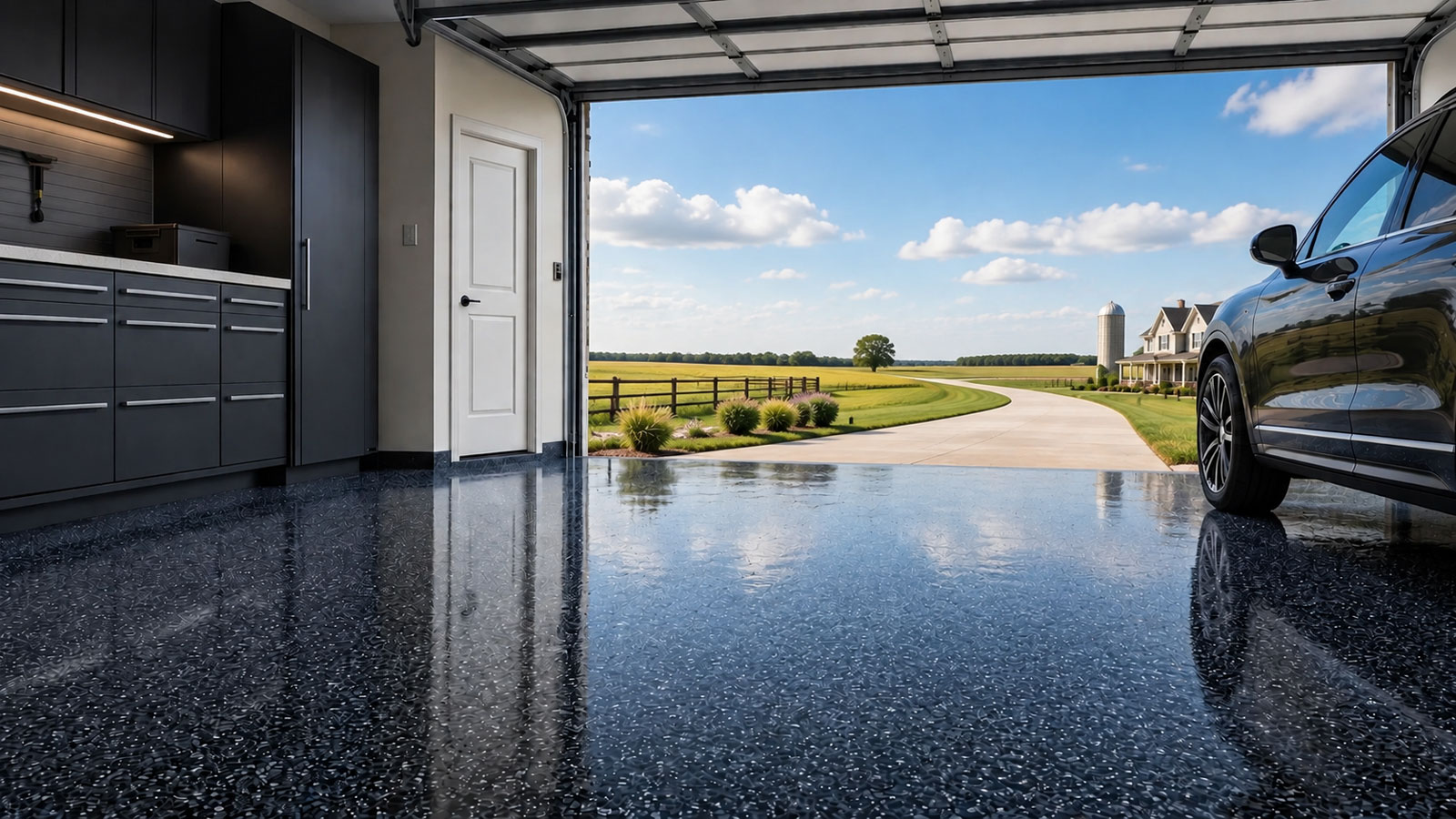
Garage Floor Coating in Gretna, NE
Floor Coating Services in Gretna, NE
Gretna was founded in 1889, but much of today's housing is the product of very recent Sarpy County growth. The city's population moved from 4,441 in 2010 to 5,083 in 2020 and then accelerated sharply as annexation and large residential projects expanded the community toward the Omaha metro. That makes surface treatment more important than visible wear on many Gretna floors. Curing compounds, sealers, dense finishes, builder patches and control joints may all require attention before coating despite the concrete being only a few years old.
Gretna operates an MS4 stormwater program and sits within the Papio-Missouri River regional drainage framework. New neighborhoods bring more roofs, streets, and driveways, so detention systems and lot grading matter even when the concrete itself is only a few years old. Rapid development also changes runoff as former open land becomes roofs, streets and driveways. Detention systems help at the neighborhood level, but driveway pitch, downspouts and threshold ponding still need a lot-specific check.
Many Gretna projects therefore begin with young multi-bay slabs rather than worn historic concrete. The likely work shifts toward removing curing products and sealers, correcting builder patches, profiling smooth concrete, and checking how a newly graded driveway handles stormwater.
Local Market Insight
Gretna’s recent growth wave makes young concrete a defining local condition. Many garages are newer multi-bay slabs where preparation is less about removing decades of old coatings and more about curing products, smooth finishes, builder repairs, control joints, and how fresh lot grading handles stormwater.
What Affects the Cost of Garage Floor Coating in Gretna?
Gretna's recent growth means many projects begin with young multi-bay concrete. Builder sealers, curing products, control joints and smooth finishes can dominate preparation, while subdivision grading, Papio-Missouri drainage, winter residue and vehicle-return timing add separate scope considerations.
Development-era slab history
Gretna was founded in 1889, but much of today's housing is the product of very recent Sarpy County growth. The city's population moved from 4,441 in 2010 to 5,083 in 2020 and then accelerated sharply as annexation and large residential projects expanded the community toward the Omaha metro. That history can change whether the main work is coating removal and repair or profiling a relatively young floor.
Local drainage and threshold water
Gretna operates an MS4 stormwater program and sits within the Papio-Missouri River regional drainage framework. New neighborhoods bring more roofs, streets, and driveways, so detention systems and lot grading matter even when the concrete itself is only a few years old. Actual water marks, ponding, and driveway slope matter more than geography by itself.
Existing coatings and surface treatments
Paint, DIY epoxy, clear sealer, curing compound, adhesive, and weak patch material must be identified and removed or stabilized before a new system is installed.
Cracks, joints, and mixed concrete
Control joints, stable cracks, repours, utility cuts, chipped edges, and garage additions can create several preparation conditions within one floor.
Seasonal vehicle residue
Winter road salt and meltwater remain practical maintenance inputs even on newer floors, while summer storms reveal drainage issues quickly.
Garage layout and use
Multi-bay layouts, steps, stem walls, cabinets, workshops, stored equipment, traction needs, and the required vehicle-return schedule all affect labor and material use.
Call for a clear, project-specific estimate — or request one online.
Gretna's current growth wave makes young garage concrete a defining local condition
Recent population and development growth means many homeowners are coating floors that have had limited vehicle use but substantial construction exposure. Paint overspray, drywall residue, rust marks, patch compounds, and clear sealers can all be present on otherwise clean-looking concrete.
That matters because a nearly new Gretna garage can look perfect and still be a poor bonding surface. Curing compounds, clear sealers, dense finishing, construction residue, and small builder patches are all reasons a young slab may need thorough mechanical profiling.
A useful Gretna estimate should therefore verify surface treatments and repairs, inspect the control-joint layout, and check the slab edge and driveway before assuming that new construction means minimal preparation.
Rapid development makes lot grading part of the coating conversation
As former open land becomes subdivisions, more rainfall runs across hard surfaces. The regional stormwater system manages that change at scale, but the homeowner still needs to know whether the specific apron ponds, a swale backs up, or downspouts discharge beside the slab.
Rapid development also makes lot grading a practical homeowner check. New streets, roofs, driveways, swales, and detention systems can move a lot of stormwater, so ponding at the apron or a driveway pitching toward the door should be noted before coating.
If the newer lot drains correctly, the project can stay focused on profiling the young concrete and selecting a finish for the way the garage is used. If runoff repeatedly reaches the threshold, exterior drainage should be corrected separately. Gretna homeowners should also keep subdivision drainage separate from slab preparation. A new neighborhood can have modern detention and still contain an individual driveway that sends water toward the garage door. Likewise, a clean-looking new floor can need significant profiling. Both conditions should be documented separately in the estimate. This is why a new garage should still be checked for both builder-applied surface treatments and property-specific runoff before the system is selected.
Before coating a Gretna garage
- Does the slab appear original to the house, added later, or made from more than one concrete pour?
- Is paint, sealer, adhesive, curing compound, or a previous coating present?
- Are cracks, patch compounds, pitting, chipped edges, or utility cuts visible?
- Does the driveway, downspout layout, or surrounding grade send water toward the garage?
- Are there water marks, efflorescence, slow-drying areas, or previous coating failures?
- Where do snowmelt, road salt, grit, or wet equipment normally collect?
- Is the garage mainly parking, storage, workshop, recreation, household entry, or mixed use?
Gretna Garage Floor Coating FAQs
Why would a nearly new Gretna garage still need heavy preparation?
Young concrete can contain curing compounds, sealers, dense machine finishes, construction residue, and builder patches that interfere with adhesion. New does not mean coating-ready.
What should homeowners in newer Gretna subdivisions check after a hard rain?
Watch the driveway, swales, downspouts, apron, and garage threshold. If water repeatedly ponds or runs toward the door, that drainage issue should be addressed separately from the floor coating.
Are Gretna garages more likely to have multi-bay layouts?
Many newer homes do, which can increase square footage, joints, edges, steps, storage obstacles, and staging requirements. Those details can affect labor and material use even when the slab is in good condition.
Does recent construction usually mean fewer repair costs?
Often there may be fewer age-related cracks or old coatings, but builder patching, control joints, sealers, and surface profiling can still make preparation a substantial part of the job.
Why can a nearly new Gretna garage still require heavy grinding or profiling?
New concrete can contain curing compounds, sealers, dense finishes or construction residue that prevent reliable adhesion. The installer should identify and remove those materials rather than assume a newer slab is ready simply because it has little visible wear.
Gretna Neighborhoods & Local Context
Phone Quote Line
Speak with a floor coating specialist about your project and get a realistic estimate range.
(402) 513-8788Typical Project Cost
$3,000–$5,500
Typical range for a two-car garage. Final pricing depends on floor size, concrete condition, prep work, coating type, and finish options.
Helpful Guides
Other Service Areas